
What happens when architecture stops being just space and becomes an experience? For Büke Kumyol, Creative Director at Ralph Appelbaum Associates (RAA), the answer lies in projects that not only shape space, but transform the way we perceive it. Belgrade 360 Deck is one of those moments, a place where Belgrade is not only observed from above, but rediscovered through the personal perspective of each visitor.
How do you approach designing spaces that “tell a story”?
I approach spatial design as a form of storytelling where architecture becomes the medium and the visitor becomes an active participant rather than a passive observer. Ultimately, I’m interested in designing environments that don’t just communicate a story, but allow people to construct their own interpretations within a carefully framed narrative structure. The goal is not to dictate meaning, but to create conditions where meaning can emerge.

How did you approach shaping Belgrade 360 Deck as a new experience of the city?
Rather than treating Belgrade 360 Deck as a conventional observation point, we approached it as a device for reframing how the city is seen and understood. The goal wasn’t just to elevate visitors physically, but to shift their perception. Ultimately, the intention was not to redefine Belgrade itself, but to create a new lens through which it can be experienced.
What was most important for visitors to feel when experiencing Belgrade from that height?
What stayed with me wasn’t just the scale, but the energy of the city. More than awe, I wanted to create a moment that feels personal. The goal is that visitors leave with a sense of invitation.
Is there a detail on the Deck that is especially significant to you?
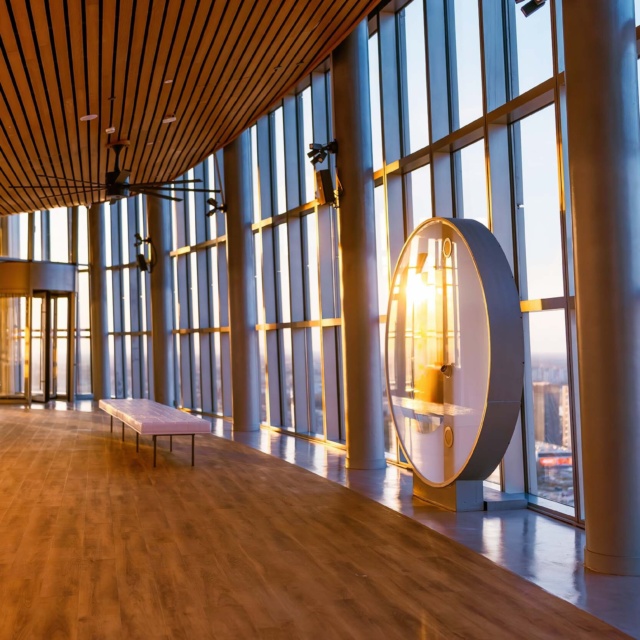
One element of the Deck that may not be immediately obvious, but is very important to me, is the Kaleidoscopes. The Kaleidoscopes allow visitors to re-encounter Belgrade in an entirely new way. The Kaleidoscopes transform the city into something lived and shared rather than simply viewed.
How do you approach the relationship between form and emotion in your work?
I don’t see form and emotion as two separate agendas that need to be balanced. Architectural form is not a container for emotion, it is one of the primary ways emotion is constructed and experienced over time. Ultimately, the goal is coherence between idea, form, and feeling.
How is RAA’s philosophy of space as a medium reflected in the Belgrade 360 Deck?
At RAA, the idea that space itself is a medium for communication is not abstract, it’s operational. Rather than treating the observation deck as a single viewing platform, I designed it as a layered communicative environment. Space communicates through movement, light, and perspective
How would you describe Belgrade in one feeling?
Belgrade, to me, is best understood as a living density of contrasts something that is not polished or resolved, but deeply vibrant because of that. The beauty of the city is not only in its architecture, but in its people and their energy. If I had to reduce it to a single feeling, it would be aliveness.
What would you like visitors to take away from the Belgrade 360 Deck experience?
I would like visitors to leave with a renewed sense of curiosity toward Belgrade itself. More than anything, I hope they take away a feeling of connection. Ultimately, the goal is for people to feel that Belgrade is not something to simply look at, but something to enter into.
Related News

EXPO 2027 in Belgrade – What to see beyond the fair
Best views of Belgrade – From Kalemegdan to the 41st floor of Kula Belgrade
Belgrade through the eyes of a foreign tourist: A view that changes the perspective of the city
PICK YOUR TIME SLOT AND SECURE YOUR TICKET IN ADVANCE.
Buy your ticket online and secure entry without waiting.